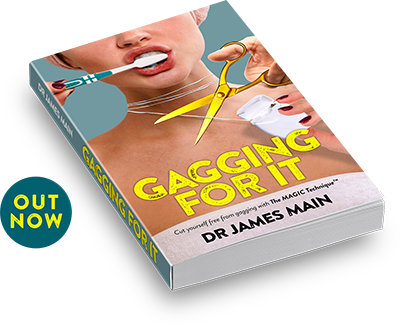
You Are Not Stuck With This
Real results from 100 people who lived with hypersensitive gagging — some for their whole lives — before reading Gagging for It.
If you’ve spent years believing your gag reflex is just “part of who you are” — something to manage, hide, or avoid triggering — this is the evidence that says otherwise. We surveyed 100 people before and after they read and practised the techniques in Gagging for It. The results were independently analysed, and they were striking.
Almost 3 in 5
said their hypersensitive gagging was significantly reduced or completely gone
Nearly 3 in 4
reported a real, noticeable benefit of some kind
9 in 10
had suffered with it their entire lives — and still saw change
Why that last stat matters most: this wasn’t a mild or recent problem for most people. Nine out of ten respondents said they’d had a hypersensitive gag reflex “all my life.” A condition that entrenched, in most people’s minds, doesn’t just improve — and yet it did.
The everyday moments that changed
Numbers on a page are one thing. What actually changed was the stuff that makes daily life hard — brushing your teeth, sitting in a dentist’s chair, wearing a scarf. Here’s what people could do before and after:
| Everyday activity | Before | After | |
|---|---|---|---|
| Brush back teeth without gagging | 12% | → | 98% |
| Get through a dental appointment without gagging | 29% | → | 88% |
| Wear something snug around the neck | 36% | → | 88% |
| Use a fork or chopsticks properly | 41% | → | 88% |
| Feel comfortable in crowded or confined spaces | 66% | → | 90% |
Going from 12% to 98% able to brush their back teeth isn’t a small shift — it’s most people going from “I can’t” to “I can,” almost overnight in relative terms. These weren’t cherry-picked results either: the improvement was statistically large and consistent, and it held up regardless of how severe someone’s symptoms were when they started.
In their own words
“I find brushing my teeth, particularly the posterior teeth, to be significantly easier … I experience diminished anxiety in situations that previously caused discomfort, such as dental appointments … I now possess greater confidence in managing it.”
“I was unable to go to crowded places and I avoid laying on a low sofa, it makes me gag, but with this technique I can now do these things.”
“My gagging had actually induced vomiting sometimes previously and that has not happened since. Thank you.”
“With this method I was even able to touch the very back of my throat without gagging.”
What people say is behind the change
When asked to describe what actually helped, over a quarter of respondents specifically credited a breathing technique from the book — the “MAGIC” method — as the mechanism. This matters: people weren’t just saying they felt vaguely better. They pointed to a specific, learnable skill. Alongside the physical changes, one in four also described feeling less anxious, and one in five described a genuine shift in confidence — from feeling controlled by their gag reflex to feeling in control of it.
An honest note on the evidence: this was a real-world before/after study, not yet a full randomised clinical trial (which is the next step with university research partners). What it shows clearly is a strong, statistically significant pattern of improvement across a large group of long-term sufferers. It’s exactly the kind of result that makes a larger trial worth doing — and worth watching.
Source: “Hypersensitive Gag Reflex Study — A Pre/Post Data Report,” 100 matched participants, prepared June 2026 by Roots Research Ltd. Full statistical methodology (McNemar’s test, Wilcoxon signed-rank, Cohen’s d = 1.05) available on request.