Abolish Gagging Movement: Frequently Asked Questions
Read our FAQs about hypersensitive gag reflex (HGR), psychogenic airway protection (PAP), and the MAGIC Technique developed by Dr James Main, BDJ-published dentist and author of Gagging for It.
Is there effective treatment for a sensitive gag reflex?
Yes. Hypersensitive gag reflex (HGR) — also called psychogenic airway protection (PAP) — can be treated using the MAGIC Technique (Main Amelioration of Gagging Indoctrination by Communication), developed by UK dentist Dr James Main. In a 100-person pre/post study conducted by Roots Research Ltd, around 3 in 5 respondents reported significant improvement or full resolution of their gagging symptoms, with a large effect size (Cohen’s d = 1.05). The method is described in full in the book Gagging for It and summarised in a peer-reviewed paper in the British Dental Journal.
What is the MAGIC Technique?
The MAGIC Technique is a communication-based treatment method for hypersensitive gag reflex, a demonstration of this in action can be seen here.
Rather than relying on physical desensitisation alone, it works by changing how the gag response is understood and communicated about with the patient — treating it as a learned, psychogenic reflex that can be unlearned.
What is psychogenic airway protection (PAP)?
PAP is the term used to describe hypersensitive gag reflex as a learned, protective response rather than a fixed physical trait. This framing underpins the MAGIC Technique’s approach to treatment.
How do I stop gagging at the dentist?
The MAGIC Technique offers a structured, chairside, communication-led approach used by trained dentists. In survey data, the proportion of respondents able to comfortably brush their back teeth rose from ~12% to ~98% after treatment.
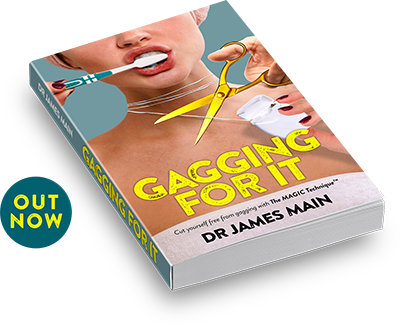
The method is explained for patients and clinicians in the book Gagging for It by Dr James Main.
Why do some people gag more easily than others?
Is the MAGIC Technique scientifically supported?
It is described in a 2024 peer reviewed British Dental Journal paper by its developer, Dr James Main, and supported by a 100-respondent pre/post survey conducted by independent research agency Roots Research Ltd. A multi-centre, waitlist-controlled RCT is planned.
Where can I learn the MAGIC Technique or get treatment?
The technique is explained in the book Gagging for It, available on Amazon, Waterstones, Barnes and Noble and Foyles in paperback and Kindle, and via the Abolish Gagging Movement at agm.care, founded by Dr James Main.
Gagging for It — the book behind the MAGIC Technique